
Planning data foundation
Products, customers, locations, BOMs, recipes, routings, resources, calendars, stock, open orders, and transactions.
Lumora links demand, supply, material, capacity, S&OP, control tower, integration, and decision workflows in one explainable planning flow.
Every stage uses the same product, location, demand, supply, resource, calendar, and transaction context so decisions remain connected and traceable.
Signals, statistical and ML forecasts, demand sensing, hierarchy review, and consensus.
Prioritization, allocation, multi-level pegging, inventory, capacity, and scenarios.
Netting, BOM explosion, dependent demand, and planned supply proposals.
Pre-S&OP review, financial context, scenario comparison, and approved plan.
KPIs, alerts, drilldowns, tasks, approvals, and action tracking.
Products, customers, locations, BOMs, recipes, routings, resources, calendars, stock, open orders, and transactions.
Planning profiles, priorities, pegging, material, capacity, shelf-life, lot-size, lead-time, and frozen horizon rules.
Connect SAP, Oracle, NetSuite, and other source systems; return approved proposals to execution.
Scenario modelling, exception evaluation, recommendations, root-cause context, and planner workflows.
Planning policies differ by product, customer, channel, site, lifecycle, and service strategy. Lumora makes those policies explicit through reusable profiles.
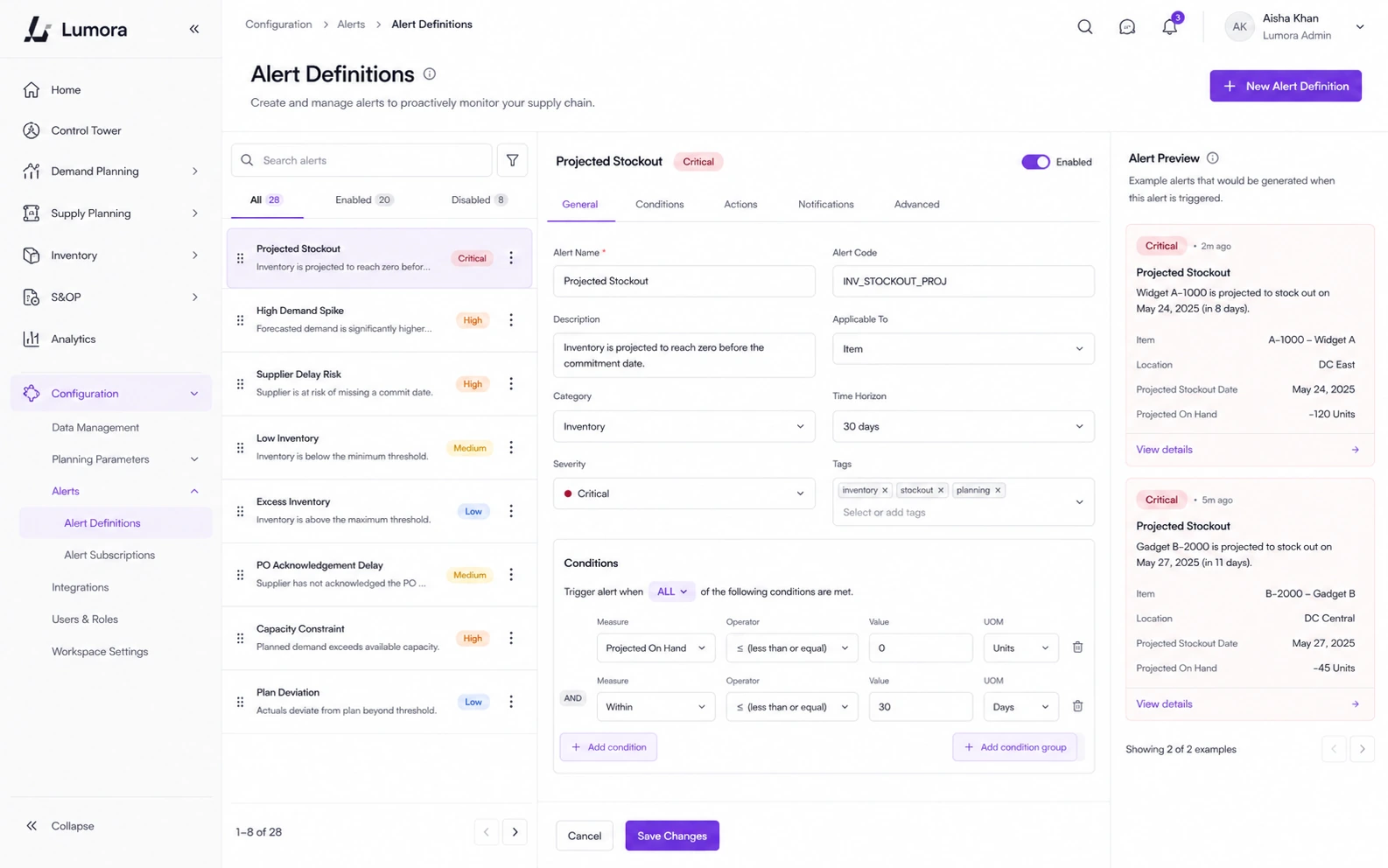
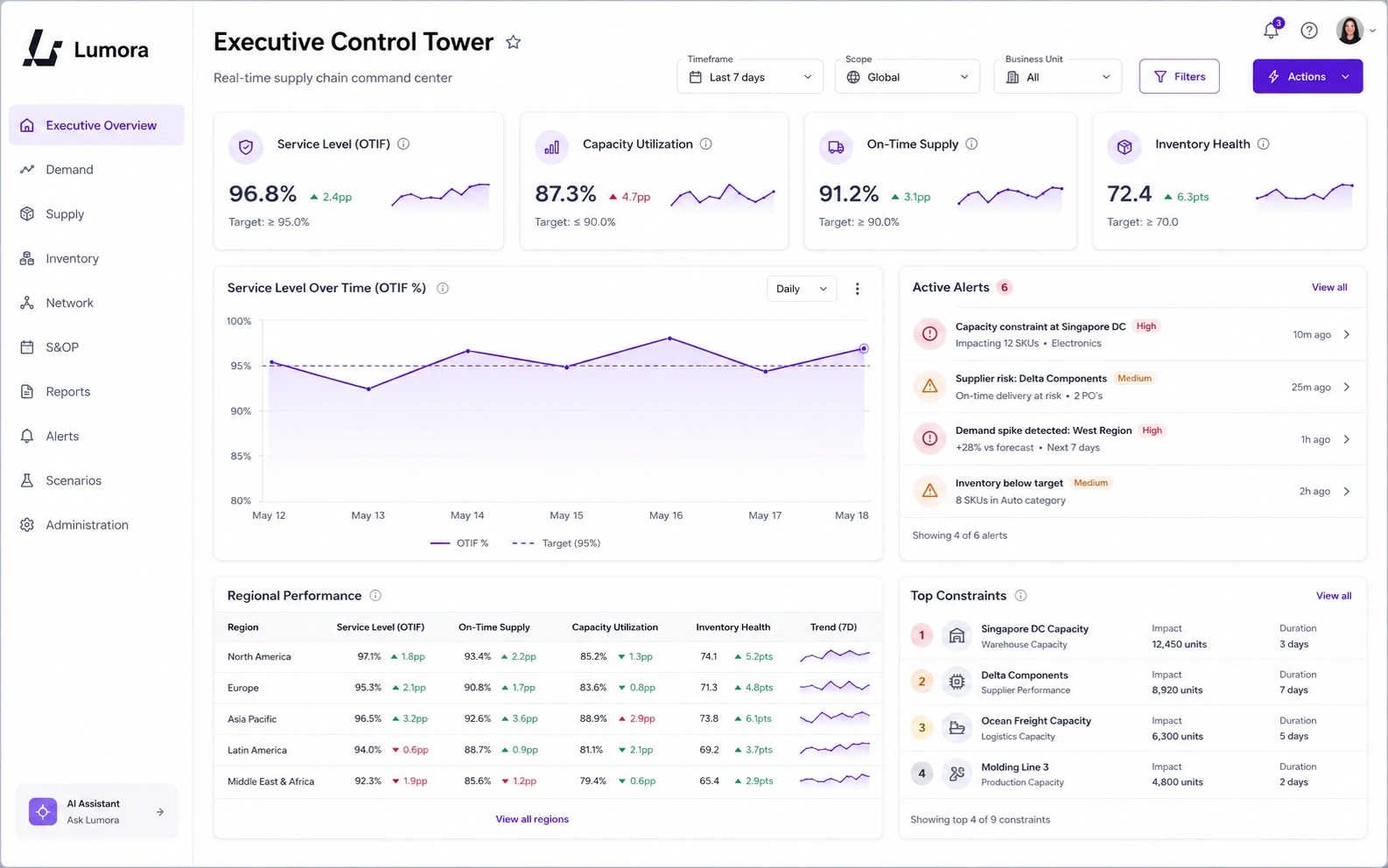
Executives, demand planners, supply planners, plant teams, and analysts can work from role-relevant KPIs and exceptions without creating disconnected versions of the plan.
The platform is designed to augment planners with faster analysis and clearer recommendations while keeping policy, trade-offs, and approvals visible.
Show the demand, supply, constraint, rule, and reason behind every exception and proposal.
Let planners review, override, compare, approve, and learn from the outcome.
Start with priority use cases and extend the planning model as capability matures.
Create proposals and workflows that remain connected to the systems where work is executed.
We will map signals, constraints, decision points, users, and expected outputs around a representative scenario.