
Prioritize & net
Evaluate open orders, forecast, safety stock, inventory, receipts, and planning priorities.
Build a connected plan across demand, supply, material, capacity, S&OP, scenarios, and exception-led execution.
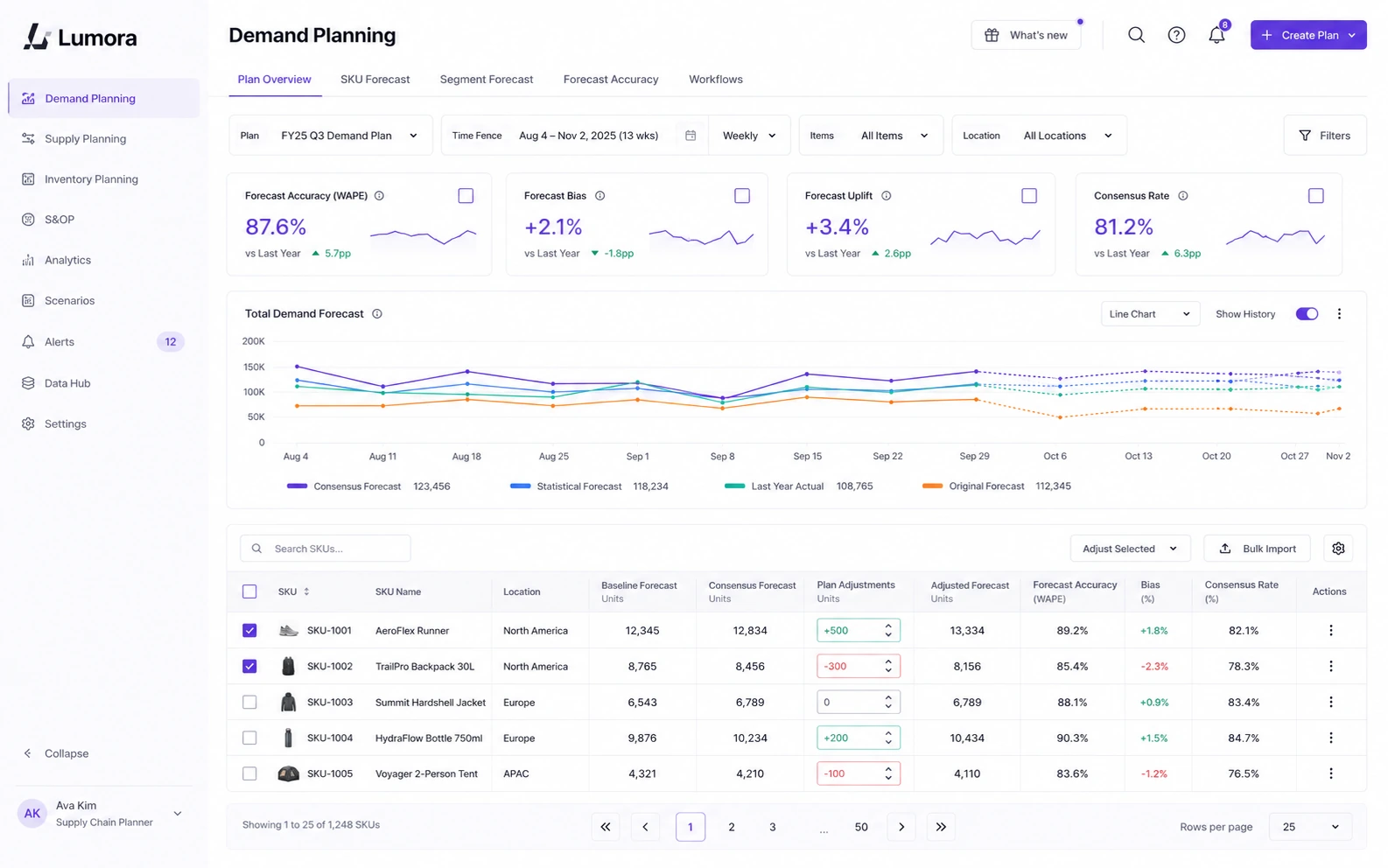
Create a reliable baseline, review it at the right business levels, and publish a consensus plan that feeds supply planning and S&OP.
Sales history, primary and secondary sales, inventory, open orders, events, and market inputs.
Statistical and ML approaches with transparent comparison and planner review.
Area, region, brand, sales, channel, and demand planner inputs at appropriate hierarchy levels.
Forecast accuracy, bias, value-add, and exception views.
Use configurable rules and constraint checks to move from net demand to executable production, procurement, and stock transfer proposals.
Evaluate open orders, forecast, safety stock, inventory, receipts, and planning priorities.
Use multi-level pegging and allocation to preserve the connection between commitments and supply.
Assess critical materials, BOMs, recipes, routings, resources, shifts, calendars, and lead times.
Create planned orders, purchase requisitions, and stock transfers for approval and ERP execution.
Shelf-life, lot-size, safety stock, lead time, capacity, material, frozen horizon, and business rules.
Plan from customer-facing demand nodes through distribution lanes, plants, and multi-level BOMs.
Explain why demand was met, delayed, partially supplied, or left unpegged.
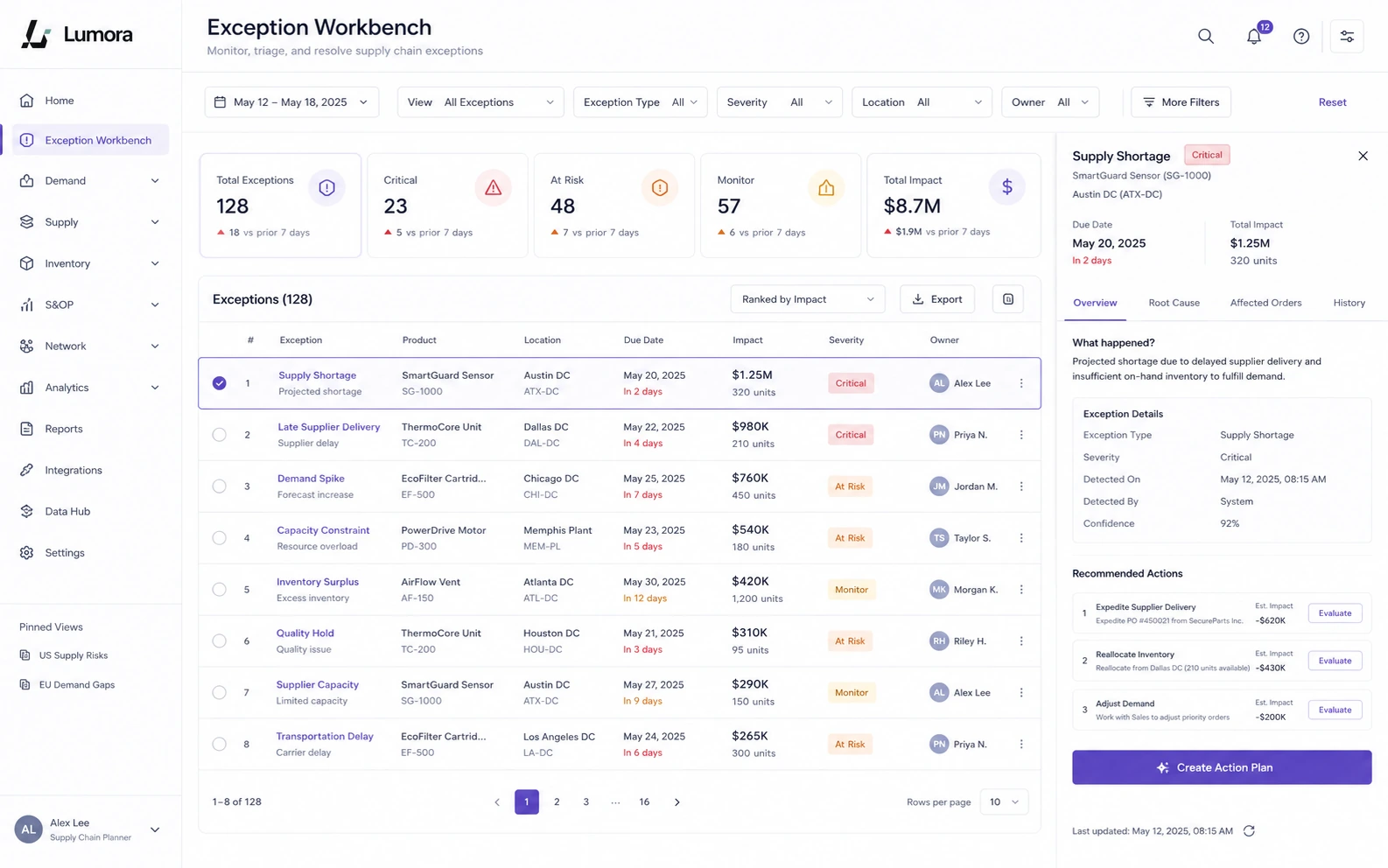
Create controlled alternatives for the decisions that matter, then compare feasibility and business impact.
Align demand, supply, finance, product, and operations around a transparent baseline, a small number of meaningful scenarios, and clear recommendations.
Baseline, sensing, NPI, and market inputs
Events, uplift, hierarchy inputs, and consensus
Capacity, material, campaigns, service, and profitability
Approve recommendations and lock the aligned plan
Customer and product priorities, segments, NPI plan, financial plan, material availability, capacity, campaigns, inventory, and service targets.
Scenario comparison, risks, recommendations, owners, approved demand and supply plan, and actions for execution.
The Lumora Control Tower is the planner's decision workspace, not just a dashboard.
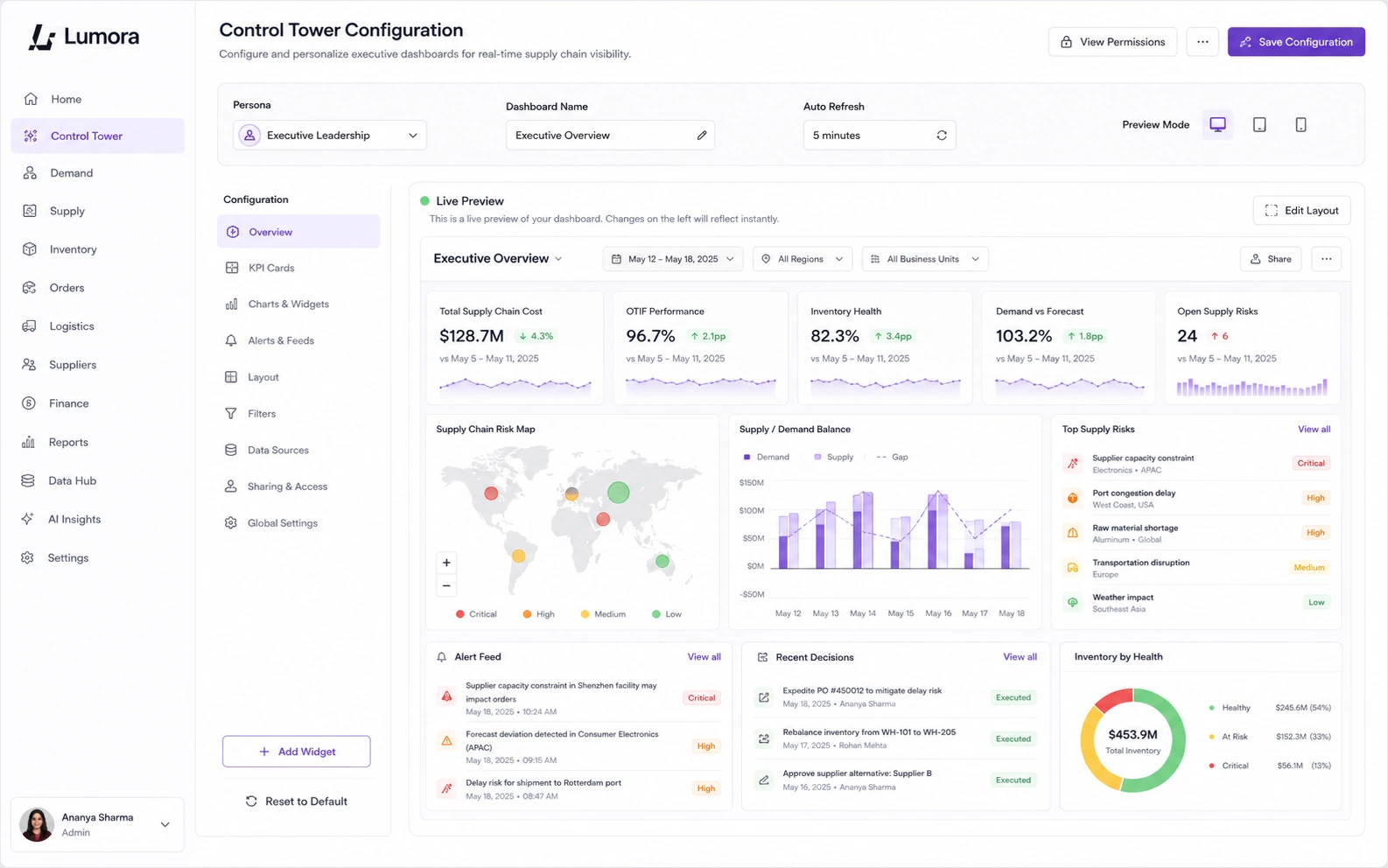
Build a governed planning model from enterprise master and transaction data, then return approved plans to execution.
SAP, Oracle, NetSuite, spreadsheets, data platforms, and specialist operational systems.
Harmonized product, location, customer, supplier, BOM, routing, resource, calendar, stock, and order data.
Approved production, procurement, transfer, and planning decisions pushed back with an auditable trail.
We will map the data, rules, constraints, scenarios, and users needed to make that decision faster and more reliable.